Notes on repairing other people’s work
A century of brass hardware passed across our bench. Here is what lasted.
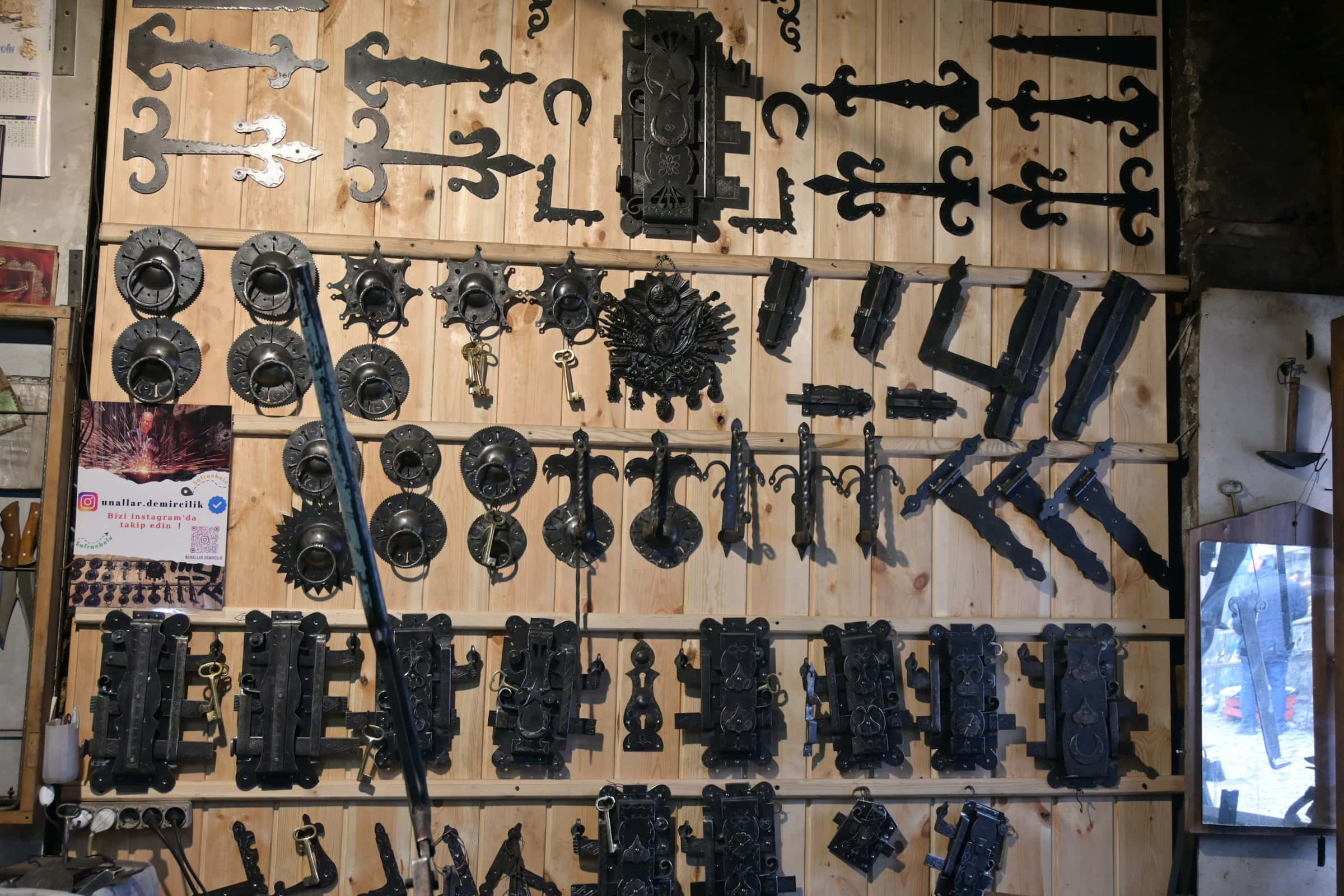
Between 2001 and about 2012 we did not make anything of our own. We repaired what the buildings around the workshop sent us, which was mostly window and door hardware from the 1880s to the 1930s. It is the least glamorous corner of Moroccan metalwork, and the one that taught us the most.
You learn things from that which you cannot learn from making.
Failures are boringly repetitive
Across roughly two thousand repairs, almost everything fell into four categories:
- Finish failure. Plating lifted, lacquer crazed. By far the largest group, and usually the reason the object was brought in at all — the mechanism was fine.
- Fastener failure. Screws into old softwood, pulled out. Rivets that were cold-set and worked loose. Almost never the metal itself.
- Wear at a bad pairing. Steel pin in a brass bearing, or worse, steel in steel with no lubrication. The softer part gives up and the joint goes sloppy.
- Abuse. Someone forced a seized latch instead of oiling it.
Note what is not on the list: the metal breaking. In twelve years I remember four cracked castings, and three of those were porous from the foundry rather than fatigued.
What that changed about how we make things
Three decisions came directly out of it, and we have not revisited any of them.
No plating, no lacquer. The largest failure category is one we can simply decline to participate in. We explain the reasoning in why we stopped plating anything.
Bronze on bronze, or bronze on steel, never steel on steel. The door knocker uses a bronze pin in a bronze bearing. Every engineer who sees it says the same metal on both faces will gall. In a hinge turning a few times a day, at hand pressure, it does not — it wears smooth and stays quiet, and it does not rust into place the way a steel pin does in a coastal winter.
Riveted rather than soldered wherever a joint sees load. A soldered joint is a repair you cannot make without heat, which means undoing the finish. A rivet can be tightened on a kitchen table in twenty years.
The guarantee is not generosity
We repair anything we made, free, for as long as we are at the bench, and we do it for pieces bought second-hand as well.
This gets described as generous. It is not, particularly. It is the cheapest possible feedback loop. Every piece that comes back tells us something a customer survey never would, and the volume is low precisely because we designed against the four failure modes above.
Last year we did nine repairs on our own work. Three were sconces that needed rewiring after twelve years, which is the flex ageing rather than anything we did. Two were bowls that had been polished with something abrasive. Four were dropped.
None of them had failed on their own.
The rest of what the repair years taught us about making — how a bowl is raised, and why the light matters — is in anatomy of a forged bowl and a north-facing window.
Questions people ask
- Why does old brass hardware fail?
- Mostly at the finish (plating or lacquer lifting), at the fasteners (screws pulled out of soft wood, loose rivets) or where a steel part wears against brass. Solid brass and bronze themselves very rarely crack.
- Can a bronze pin run in a bronze bearing?
- In hardware turned by hand a few times a day, yes. It wears smooth and stays quiet, and unlike steel it does not rust solid in damp or coastal weather.
- repair
- hardware
- marrakech