
Two makers, one courtyard, twenty-five years.
We started by repairing old brass hardware for the buildings around us. The repairs taught us what lasts, and eventually what to make ourselves.
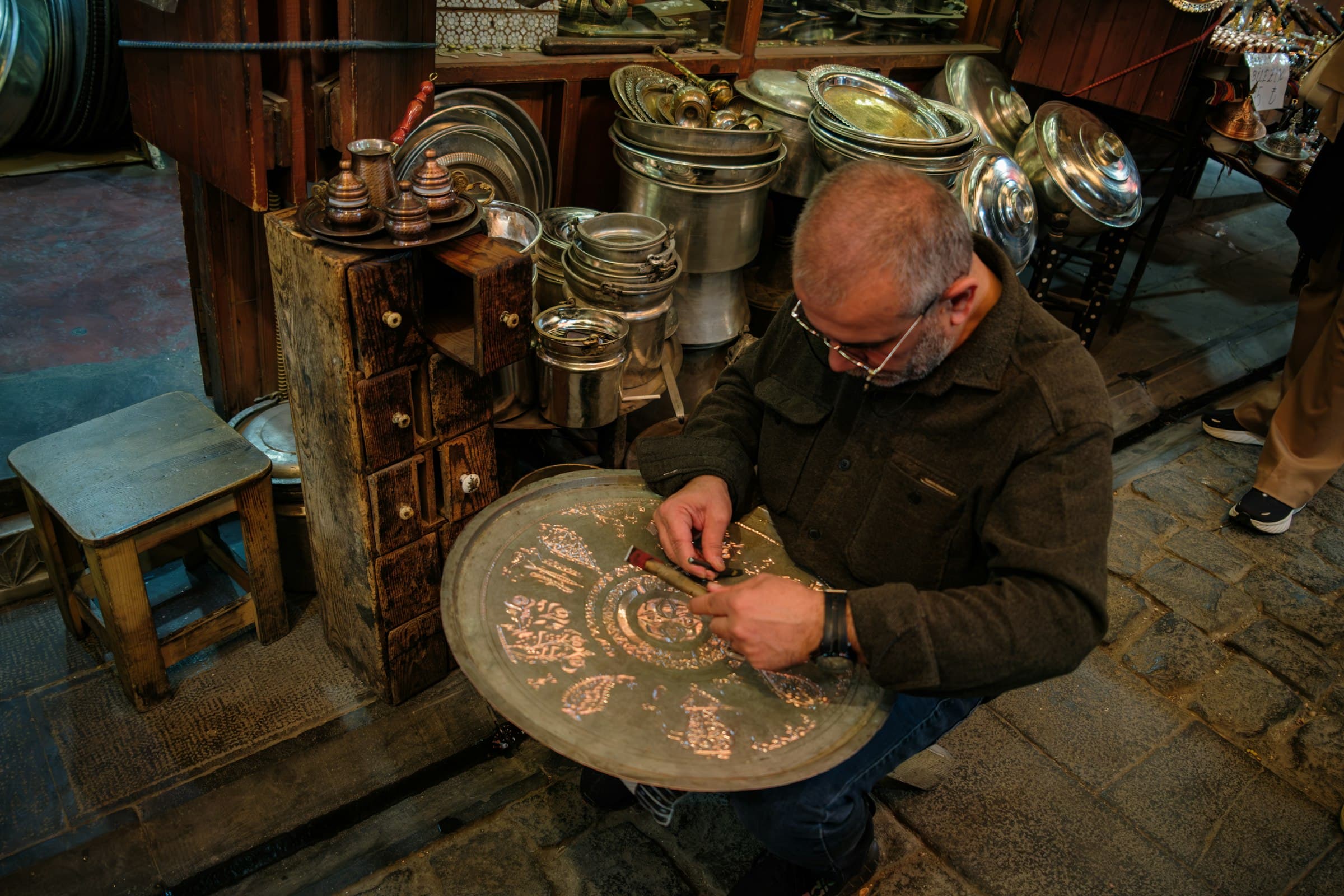
The workshop sits behind a door in the old quarter of Marrakech. It has two benches, a coke forge, a fly press our predecessor left behind, and a window that faces north because that is the light you want when you are judging a surface.
For the first decade we did not make anything of our own. We repaired: door bolts, casement stays, sconces and lantern frames from houses built when the quarter was new. A century of other people’s brass passed across the bench. It is an unusual education. You learn very quickly which joints fail, which finishes lie, and which objects were made by someone who expected to be judged on them.
What we learned is that almost everything that fails, fails at the finish. Plating hides the metal underneath and then flakes off it. Lacquer yellows, then peels, then traps the tarnish it was meant to prevent. The pieces that were still good after ninety years were the ones left bare — solid metal, no coating, allowed to darken.
So we do not plate and we do not lacquer. A piece leaves the workshop polished or brushed or blackened, and then it is yours to age. Unlacquered brass takes a patina within months: warm where hands touch it, darker where they do not. You can polish it back whenever you like. Both states are correct.
The range is small on purpose and grows slowly, because a piece only joins it once we have made it enough times to know what it should cost and how long it should take. Everything else we make to order. Nothing leaves the courtyard that we would not keep ourselves.
- Years at the bench
- 25
- Tallest piece, hand-pierced
- 1 m
- Made in-house
- 100%
How the metal ages
- Day one
Bright
Polished or brushed at the bench and sent out bare. The colour is the metal itself, with nothing laid over it.
- Three months
Warming
The shine softens to honey. Fingerprints stop showing and start settling in, wherever the piece gets handled.
- One year
Patterned
Darker in the recesses, lighter on the edges you touch. The piece begins to record how it is used.
- Ten years
Settled
A deep, even brown that protects the metal underneath. A cloth and some polish bring it back to day one whenever you like.
How a commission runs
- 01
Write to us
Send dimensions, the metal you have in mind, and your deadline. Photographs of the space help more than drawings do.
- 02
Quote within two days
A fixed price and a date. If what you want is a bad idea in brass, we will say so and suggest what to do instead.
- 03
Sample, then the run
For anything above six pieces we make one first and post it to you. Nothing goes into production until you have held it.
- 04
Delivered and registered
Insured and tracked. We keep the pattern and the notes, so a matching piece in five years is a phone call, not a redesign.
- Materials
- Solid brass, bronze, copper and blackened steel. No plating, no lacquer, nothing to chip away.
- Made in
- Marrakech, in a courtyard workshop of two people. Every piece passes through both pairs of hands.
- Lead time
- Catalogue pieces ship in five working days. Commissions run four to six weeks.
- Repairs
- Free mending on anything we have made, for as long as we are at the bench.
The door is open three days a week.
Le Noyer, rue Ibn Sina, 4e étage n° 41, Guéliz, 40000 Marrakech. Visits Thursday–Saturday, 10–18. Write ahead so someone is at the bench rather than at the merchant when you arrive.
Plan a visit